

How the UNI 60 works
Inside the UNI 60 — the firebox, the three-pass flue path, the forced-draft fan and the TIS Tronic 260U controller, with the labelled factory section drawings.
The UNI 60 burns a full firebox of wood slowly under fan-controlled air, then pulls the hot flue gas back through three heat-exchange passes before it reaches the chimney. The controller modulates the fan to hold a target water — or exhaust gas — temperature, so one load can run for hours instead of burning out in one rush.
The combustion path
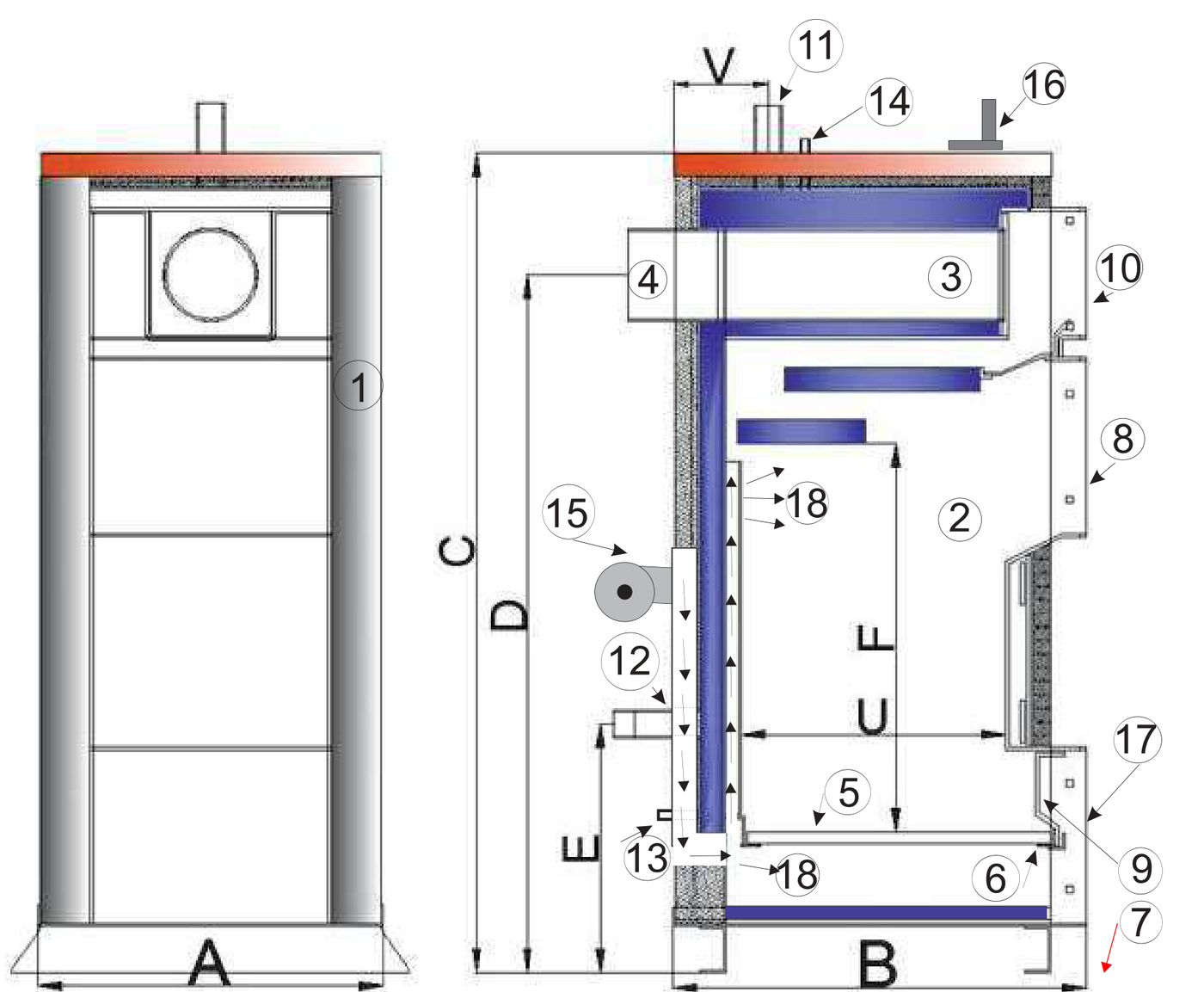
The numbered callouts in the drawing map to these parts:
| # | Component | # | Component |
|---|---|---|---|
| 1 | Body | 10 | Service flue gas door |
| 2 | Furnace | 11 | Supply pipe connection |
| 3 | Flue gas 3rd pass | 12 | Return pipe connection |
| 4 | Chimney connection | 13 | Drain pipe |
| 5 | Grate set | 14 | Temperature sensor well |
| 6 | Support | 15 | Fan |
| 7 | Ash pan | 16 | Controller |
| 8 | Fuel loading door | 17 | Ash door |
| 9 | Ash removal door | 18 | Direction of air during combustion |
The ash pan sits outside the boiler
Unlike the drawing's internal position, the ash pan on delivered units goes outside the unit, at the front of the ash door.
What happens on one load
Loading. Split wood goes in through the fuel loading door (8) onto the grate set (5). The UNI 60 firebox holds 58 gallons and takes logs up to 26 in long.
Ignition and firing up. The controller runs the fan hard for the firing-up period to establish the fire quickly. In Brager Expert exhaust gases mode it holds the exhaust target at 300 °C during this window.
Controlled combustion. The fan (15) forces air into the furnace along the path shown by arrows 18. Because air is metered rather than free, the load burns from the top or the bottom over many hours instead of all at once.
Three-pass heat extraction. Flue gas leaves the furnace (2), turns through the flue gas passes and the third pass (3) above the firebox, giving up heat to the water jacket on the way, and exits through the chimney connection (4).
Supervision. Once the water reaches setpoint the controller drops into supervision: the fan stops and only pulses briefly at a low speed to keep the coals alive without overheating the boiler.
Quenching. When the fuel runs out — detected by falling water temperature or falling exhaust temperature — the controller stops the fan, lights the STOP indicator, and optionally stops the circulation pump.
Inside the water jacket
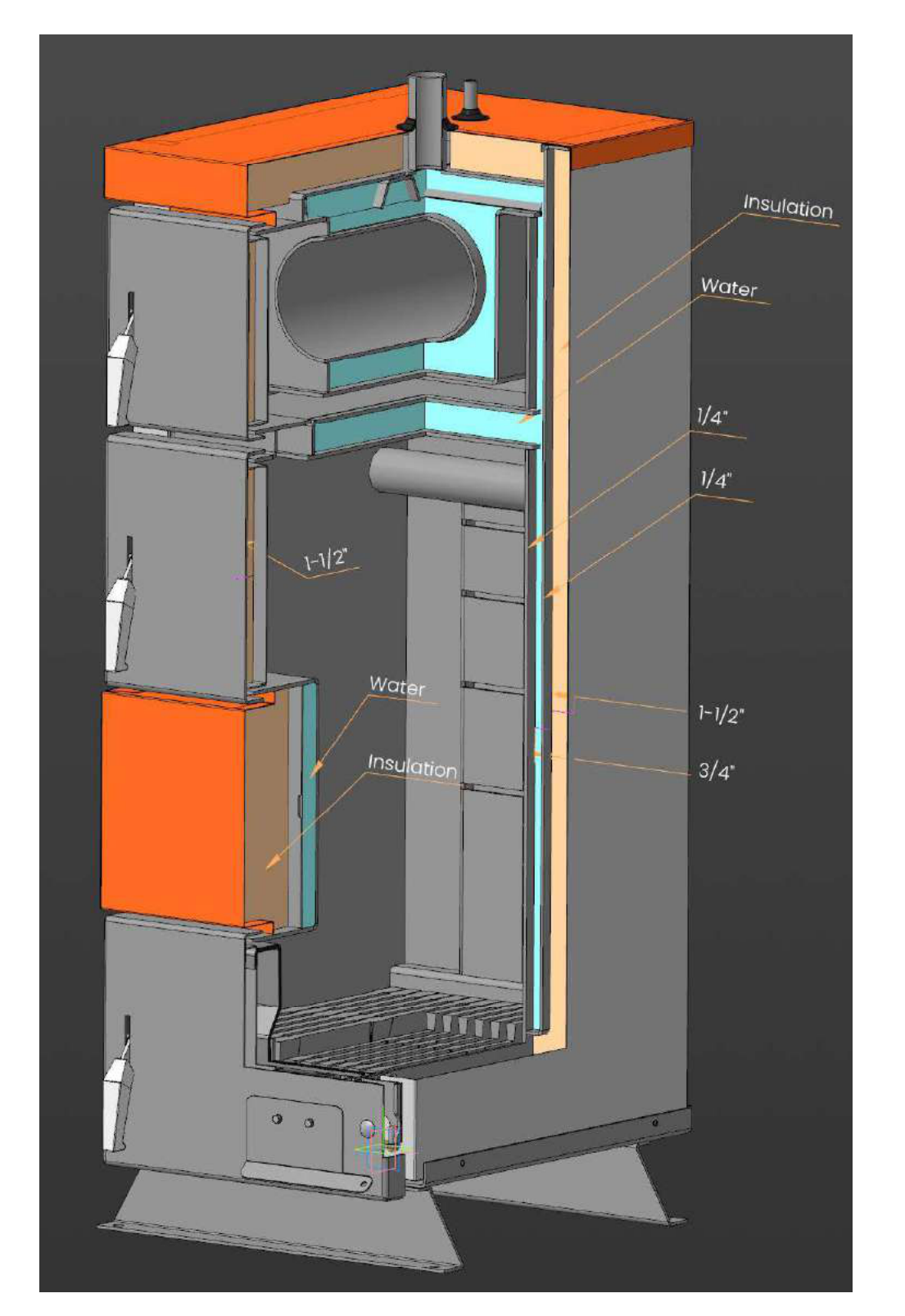
Water wraps the firebox and the flue passes, and the whole assembly is wrapped again in mineral wool. The plate thicknesses called out in the drawing range from ¼ in on the outer surfaces to 1½ in at the heaviest sections, which is what gives the boiler its thermal mass and its 1,224 lb weight.
The insulation and steel both carry fire safety classifications:
| Material | Thickness | Class rating |
|---|---|---|
| Mineral wool insulation | 1½ in | Class A1 |
| EN 10051/10 mild steel | ¼ in | Class A* |
What the controller adds
The TIS Tronic 260U turns a wood fire into a thermostatically controlled heat source. It:
- drives the fan with variable speed, which is the only real throttle a wood boiler has;
- reads the boiler water temperature (
T1) and, optionally, the exhaust gas temperature (T3); - starts and stops the central heating pump (
Q3) and the domestic hot water pump (Q4); - responds to a room thermostat on
I2; - and is backed by an independent STB bimetallic sensor on
I1that cuts the fan if the water passes roughly 90 °C, regardless of what the software is doing.
That last point matters: the safety chain is hardware, not firmware. See Electrical and sensors.
Fuel flexibility
The UNI is a universal solid-fuel boiler — it runs on wood, coal, peat, woodchips and mulch. Fuel choice changes both output and maintenance intervals: wood deposits more tar and soot in the chimney than coal, so wood-fired units need more frequent sweeping. Details are in Fuel properties.
Never burn waste
Burning waste, plastics or flammable liquids releases poisonous gases and will damage the boiler. Use recommended fuels only.
Every published figure for the UNI 60, plus the full UNI range for comparison.
Quick start
The complete UNI 60 project in eleven ordered stages — from unpacking the crate to the first heating season, with links to the detailed page for each step.
UNI 60 specifications
Full published specifications for the MBtek UNI 60 wood boiler — 85–205 KBTU output, 40 gal water volume, 58 gal firebox, 2 in connections, 8 in flue and 1,224 lb weight.