First firing
Light the UNI 60 for the first time — check the draft, set the controller, load the firebox, ignite, run Start Fire, and stay with the boiler.
The first firings must be carried out by a trained installer or service technician, and the boiler must not be left unsupervised during them. By this point the system should be filled, vented, wired and configured — see the commissioning checklist.
Lighting the boiler
Check the draft in the chimney
Hold a strip of paper at the ash pit — it should deviate to the side of the ash pit. Confirm the ventilation openings for inflow and exhaust have not been restricted or blocked.
Set up the controller
Load the MBtek recommended settings. Confirm the fan type is WPA 07 / DM85 and the mode is Brager Expert exhaust gases (or Brager Expert without the PT1000 sensor).
Fill the furnace with fuel
Use dry wood — aim for 20 % moisture or below. Logs up to 26 in; the firebox holds 58 gal.
Ignite from the top or the bottom
Both are acceptable. Top-down ignition generally produces less smoke on a cold start.
Never use flammable liquids to start the fire
Use kindling and a firelighter.
Wait for the fuel to inflame
Monitor the combustion process constantly during this stage. Then close the door tightly.
Activate "Start Fire"
Run the Start Fire function in the controller. The START indicator flashes during ignition and becomes constant once the controller is in automatic operation mode.
Watch the first cycle through
Stay with the boiler. Confirm:
- the fan runs and the fan indicator lights;
- the boiler temperature climbs;
- at 35 °C / 95 °F the pumps start and the CH pump indicator lights;
- the exhaust temperature settles into the 160–240 °C band (with the PT1000 fitted);
- at setpoint the boiler drops into supervision and the fan starts pulsing.
Adding fuel
Turn the fan OFF before adding more fuel, then observe the precautions.
Backdraught risk
Combustion running with a limited air supply can ignite suddenly when the door is opened and air rushes in. Open the door slowly and stand to the side. Do not open the doors for a long time while the boiler is firing.
Filling of fuel — wood, coal, briquettes — must be done before combustion, not into a roaring fire.
If the fire fails to establish
| Symptom | Likely cause |
|---|---|
| Failed fireup alarm | Firing-up time expired without the boiler temperature rising above shutdown temperature + 2 °C |
| Fan hums but does not turn | Minimum fan speed too low — raise to 40 % |
| Smoke back into the room | Poor draft: cold chimney, blocked flue, restricted ventilation openings, too many bends |
| Fire dies after ignition | Wet fuel, insufficient kindling, supervision settings too lean |
Use a chimney fan on start-up for best comfort and minimal fume migration into the house. Smoke hoods are a second option.
Optimising after the first burns
Settings are a starting point
The boiler manual is explicit: to achieve high-quality and reliable operation, controller parameters must be optimised, and it is necessary to agree them with a professional instructed by your local distributor.
Watch the first few burns and adjust using the tuning notes.
Flame bumper (older units)
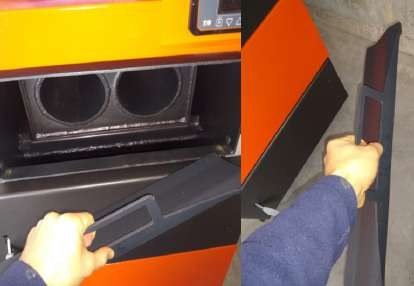
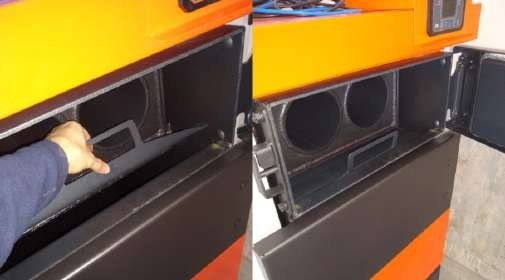
If you are commissioning an older UNI unit, confirm the flame bumper is fitted before firing.
NextDaily operationLoading, ash removal and running the boiler through the week.
Frequently asked questions
Wiring reference
Complete TIS Tronic 260U terminal map, sensor schedule, output ratings and fuse specification, with the board diagram and hydraulic connection drawing.
Daily operation
Running the UNI 60 day to day — loading the firebox, removing ash, watching pressure and temperature, and the habits that keep efficiency up.